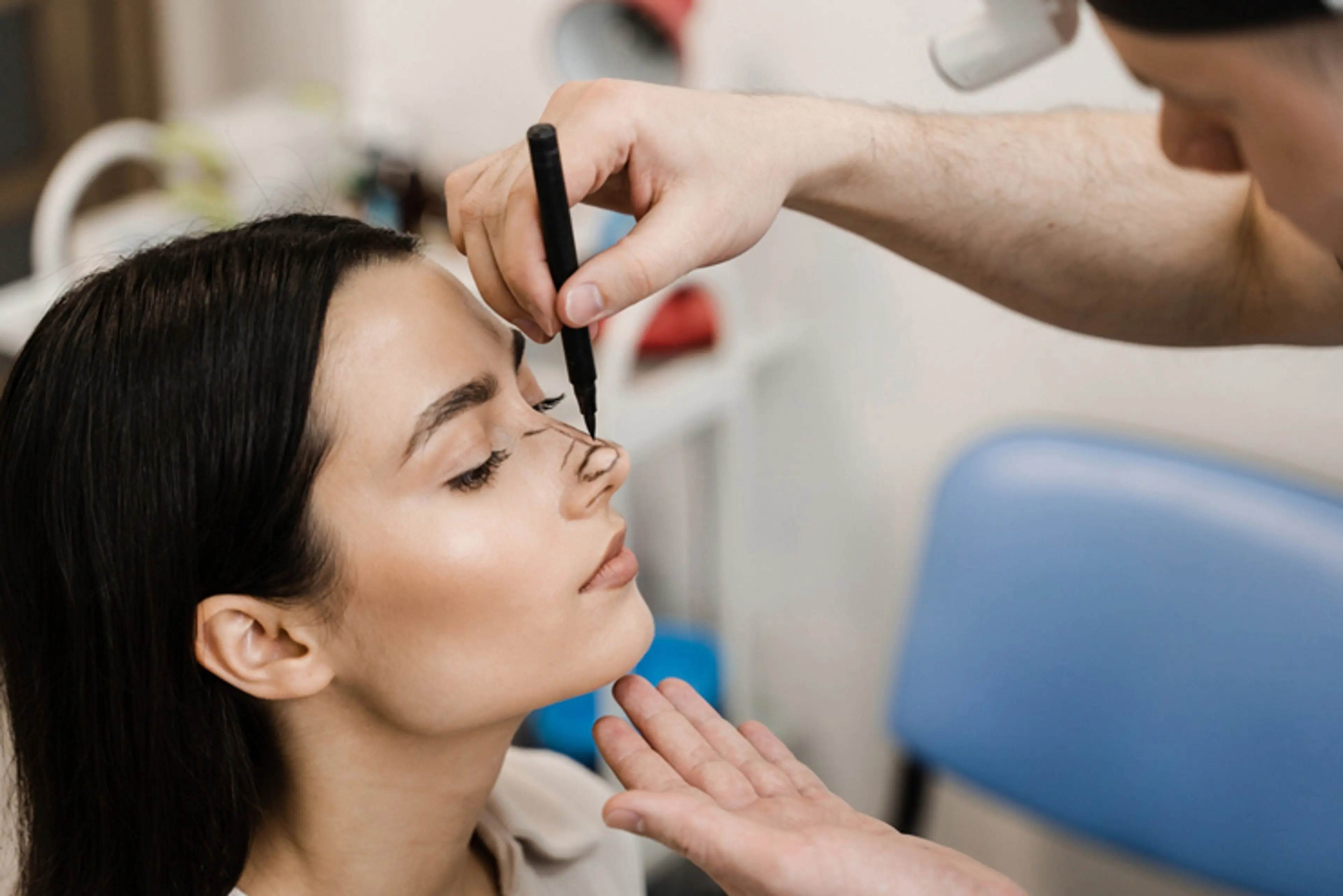
You’ve had a nose job before. Maybe it was recent, maybe it was years ago. But now, every time you look in the mirror, there’s something that still doesn’t feel quite right. A small asymmetry. A slight dip or bump that wasn’t there before. Maybe your breathing feels a bit restricted, or your nostrils don’t match.
It’s not severe. But it’s enough to bother you.
If that sounds familiar, you’re not alone. Many patients seek minor revision rhinoplasty not because their original surgery was a failure — but because it left room for subtle improvement.
At Kowon Plastic Surgery in Seoul, we see this often: patients who are mostly satisfied with their previous rhinoplasty, but still feel that something small is "off." Whether it’s a visible imperfection or a mild functional issue, minor revision rhinoplasty offers a precise, tailored approach to refine the results — without the complexity of a full redo.
But what actually happens during a minor revision rhinoplasty? What makes it different from major revision cases? And how do we ensure safety and harmony, even in the smallest corrections?
Let’s break it down from the inside out.
What Is a Minor Revision Rhinoplasty?
what-is-a-minor-revision-rhinoplastyMinor revision rhinoplasty refers to a secondary nasal surgery that addresses small aesthetic or functional issues left unresolved after a previous rhinoplasty. These may include:
Slight asymmetry or contour irregularities
Visible irregularities on the bridge or tip
Over- or under-correction in projection or rotation
Mild breathing difficulties from minor structural changes
Scar tissue complications
Alar retraction or nostril imbalance
Unlike major revisions, which often involve structural rebuilding or correction of significant deformities, minor revisions are usually localized, low-risk, and quicker to perform. They do not typically require rib cartilage grafts, major cartilage reconstruction, or complex implant removal (though there are exceptions).
Still, even small adjustments require high-level precision and planning. Because with revision surgery, the tissue has already been altered once — and any further change must be delicately managed to avoid new problems.
Why Do Patients Seek Minor Revisions?
why-do-patients-seek-minor-revisionsRhinoplasty is one of the most complex procedures in plastic surgery. Even with an experienced surgeon and a well-healed nose, outcomes can evolve subtly over time — especially as swelling resolves or scar tissue forms.
At Kowon, we always emphasize realistic expectations. No nose is 100% symmetrical, and perfect symmetry isn’t the goal. But when a patient notices something that distracts from the overall balance of their face — even a few millimeters — that’s valid, and often addressable.
Common motivations include:
common-motivations-include:“I like my new nose, but the tip looks pinched when I smile.”
“There’s a small bump that showed up months after the surgery.”
“One nostril is just slightly higher than the other.”
“I’m happy overall, but it could be a bit smoother from the side.”
These aren't overhauls — they’re refinements. But they can make a world of difference in patient confidence.
How Do We Approach Minor Revision Surgery at Kowon?
how-do-we-approach-minor-revision-surgery-at-kowon
Minor revisions require a different mindset than first-time surgeries. Here’s how we approach it at Kowon:
1. Comprehensive Evaluation
1.-comprehensive-evaluationWe begin with a thorough consultation, including 3D imaging and functional assessment. We examine:
What the original surgery changed
How the tissue healed over time
Where the subtle imbalance lies
What the patient wants corrected — and why
This part is crucial. Sometimes, what patients perceive as an imperfection is actually normal anatomy reasserting itself. Other times, the issue is deeper — such as a twisted septum or collapsed valve — and not visible externally.
Understanding both form and function is key.
2. Surgical Planning Focused on Minimalism
2.-surgical-planning-focused-on-minimalismIn minor revision surgery, less is more.
We plan a highly targeted intervention to address the specific issue without disrupting the rest of the nose. This may involve:
Shaving down a small bump
Smoothing a slight irregularity on the dorsum (bridge)
Adjusting the cartilage at the tip
Correcting mild nostril asymmetry
Removing small amounts of scar tissue
Reinforcing weak structures with minimal grafts (ear or septal cartilage)
Unlike major revisions, we typically do not use rib cartilage unless prior surgeries have depleted other sources. We also avoid overcorrection — the goal is refinement, not reinvention.
3. Local or Sedated Anesthesia Options
3.-local-or-sedated-anesthesia-optionsDepending on the scope, minor revision rhinoplasty can often be performed under:
The entire procedure usually takes 30 minutes to 1.5 hours, compared to 3–4 hours for major revisions.
What Happens During the Procedure?
what-happens-during-the-procedureEvery case is unique, but here’s a typical sequence during minor revision rhinoplasty:
Accessing the Tissue
accessing-the-tissueA small incision is made — often using a closed (endonasal) technique, which avoids external scars. If more access is needed, a limited open approach may be used, hidden within the columella (the skin between the nostrils).
Correcting the Imperfection
correcting-the-imperfectionUsing delicate tools, we:
Remove excess cartilage or bone if there’s a small bump
Add cartilage (from the ear or septum) to correct dips or asymmetries
Reposition existing structures for balance
Trim excess tissue or remove scar adhesions if present
Functional Reinforcement
functional-reinforcementEven minor cosmetic revisions can affect airflow. We always assess internal valve function, septal support, and mucosal integrity. If there’s even mild obstruction, we correct it proactively using conservative spreader grafts or suture techniques.
Closure and Support
closure-and-supportAfter correction, we re-drape the skin and close incisions with ultra-fine sutures. A light external splint is placed — often for just 3–5 days.
Most patients do not require internal packing unless functional work was done.
What Is Recovery Like?
what-is-recovery-like
Recovery from a minor revision rhinoplasty is typically:
Shorter: Swelling lasts 1–3 weeks, with most visible signs gone by day 10
Less painful: Patients often report mild discomfort or pressure, not pain
More predictable: Because less tissue is disrupted, the healing curve is smoother
You can usually return to work within 5–7 days, and light exercise within 2–3 weeks. Final results settle over 3–6 months, though visible improvement is often immediate.
We monitor every patient closely during this phase — with follow-ups at 1 week, 1 month, and 3 months to ensure optimal healing.
Risks and Considerations
risks-and-considerationsEven minor revisions carry certain risks, such as:
Prolonged swelling or bruising
Infection (rare, especially with proper technique)
Overcorrection or undercorrection
Persistent asymmetry
Scar tissue development
Minor breathing changes
That’s why choosing the right surgeon matters just as much as the surgery itself.
Revision noses are less forgiving than untouched ones. The tissue memory, scar dynamics, and vascular patterns are altered — which is why seemingly “minor” adjustments still require major precision.
Why Kowon?
why-kowonAt Kowon Plastic Surgery, we specialize not just in rhinoplasty, but in safe, natural-looking revision rhinoplasty. Led by Dr. Kim Hyung Taek, we’ve helped thousands of patients — including those traveling from overseas — correct both minor and major nasal issues with artistry and care.
Our approach to minor revisions is rooted in:
Conservative correction — never overdoing it
Function-first philosophy — aesthetics and breathing are inseparable
Implant-free solutions wherever possible
Attention to millimeters, not just millimeters of fame
Dr. Kim has pioneered rib cartilage-based techniques, but equally values minimalistic adjustments that avoid further trauma to the nose. Often, the most successful revision is the one you can’t even tell happened — it simply looks right.
Final Thoughts: When a “Small Fix” Makes a Big Difference
final-thoughts:-when-a-"small-fix"-makes-a-big-differenceIf your nose is 90% where you want it to be, but one detail keeps bothering you — that’s worth listening to. A minor revision rhinoplasty can refine the outcome, restore confidence, and, when done well, feel like the nose you were always meant to have.
But remember: what looks like a small change on the outside often requires expert hands on the inside. Precision, not aggression, defines the success of minor revision surgery.
Considering a Minor Revision?
Don’t rush. Let your nose fully heal after your first surgery (usually 6–12 months), then consult with a clinic that specializes in high-safety, detail-focused revisions.
At Kowon Plastic Surgery, we’ll help you understand whether a minor revision is right for you — and if so, how to achieve the result you originally hoped for.